
The Secret Reef Alliance: When Grouper and Moray Eel Hunt in Tandem

We often imagine the ocean floor as a ruthless world where it’s every creature for itself. Yet, if you ever dive into a coral reef, you might stumble upon a spectacle that completely shatters our view of nature: a grouper and a moray eel teaming up.
It was in 2006 that Swiss ethologist Redouan Bshary brought this incredible behavior to light. Far from being a coincidence, it is a genuine, active collaboration. This fascinating phenomenon can mainly be observed in the warm, tropical waters of the Red Sea and the Indo-Pacific Ocean, driving these two species to link their fates.
1. Two Profiles, Two Worlds: A Duo of Opposites
At first glance, our two protagonists have nothing in common, starting with their biological clocks. The Roving Grouper (Plectropomus pessuliferus) is a big fan of the daytime, while the Giant Moray Eel (Gymnothorax javanicus) is a deeply nocturnal creature. Yet, they manage to align their schedules, often at dusk or in the middle of the afternoon (even if the grouper has to go and wake its partner up from the depths of its hole!).
Physically, they are perfect mirrors of each other:
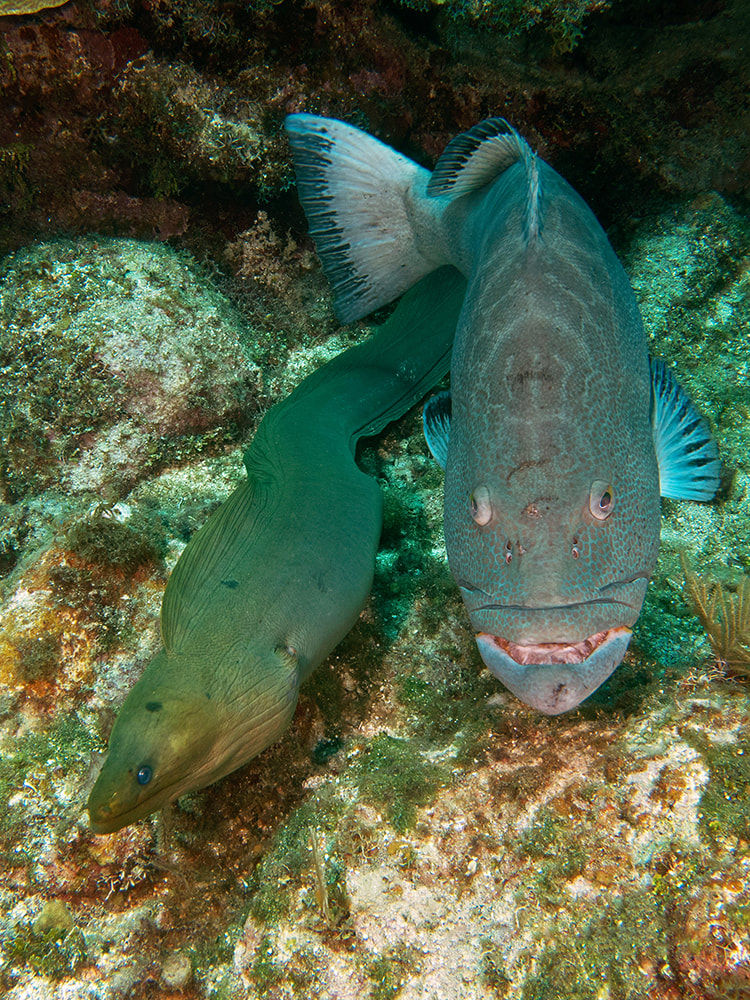
The Grouper: A robust ambush hunter operating in open water. When it spots prey, it lunges and vacuums it up in one swift gulp. The problem? Its massive body prevents it from squeezing into the coral labyrinths where small fish rush to hide as soon as they get scared.
The Moray Eel: It spends its days hidden among the rocks. Thanks to its snake-like body, it is the queen of inaccessible crevices. Its weak point? In open water, it is far too slow to catch a fast fish.
This is where the magic of evolution happens: where the grouper fails, the moray eel succeeds, and vice versa. By pairing up, they simply cancel out their respective weaknesses.
2. The Underwater "Check": An Almost Human Communication
When the grouper sees prey escape and dart into a hole, it doesn't give up; it swims straight to the moray eel's lair.
There, it begins a brief, highly theatrical ballet: it holds itself head-down and shakes its head frantically from left to right. If the moray eel accepts the invitation, she comes out, and the grouper guides her like a scout to the prey's hiding spot. Once there, the grouper shakes its head again to point out the exact crevasse. For biologists, this was a historic discovery. Indeed, this is a referential gesture. It is the exact equivalent of us pointing our index finger at something—an extremely rare occurrence in the entire animal kingdom!

For us, it shows one thing above all: the grouper knows exactly what it is doing. By seeking out the moray eel because she has the physical ability to go where he cannot, he proves that he understands his partner's skills. In science, this is called the "Theory of Mind"—a higher cognitive faculty once thought to be reserved for humans, great apes, or certain highly intelligent birds.
3. A Perfect Trap with No Arguments
Once the moray eel slips into the rocky labyrinth, the trap snaps shut. Outside, the grouper stands guard in open water. For the prey, it is an absolute nightmare of a dilemma, and the duo's success rate is multiplied by five. The outcome usually boils down to two scenarios:
The Moray Option: She corners the fish at the end of a dead-end and swallows it.
The Grouper Option: The prey panics, flees the hole to escape the moray, and darts straight into the jaws of the grouper, who was waiting firmly in place.
One might expect that once the prey is caught, the tension would rise or they would fight over the leftovers. Well, not at all. There is no sharing. It is a strict rule of "first come, first served," and whoever catches the fish swallows it whole.
Strangely enough, it is this binary system that guarantees long-term peace and what is known as the "predator truce." The moray knows the grouper is too big for her, and the grouper knows the moray has razor-sharp teeth and that he needs her alive for future hunts. If the moray comes back empty-handed because the grouper ate, she doesn't get upset: she knows luck will turn at the next hole.

But beware, this partnership relies on trust, and cheating is absolutely forbidden! Groupers possess an excellent long-term memory. If he encounters a lazy moray eel that refuses to hunt for the prey after accepting the invitation, he remembers it. During subsequent hunts, the grouper will snub this bad teammate and recruit a different individual. This undeniably proves that they have a real awareness of each other's individuality.
In Conclusion...
The story of the grouper and the moray eel reminds us quite poetically that nature is not just made of conflict. Reciprocal altruism and collective intelligence also exist beneath the surface. It is a beautiful lesson in cooperation, where the other's difference becomes your greatest strength.
As a fun side note, you should know that the grouper is the true king of underwater networking. When his moray eel buddies are unavailable or sleeping too soundly, he has been known to perform the exact same "head dance" in front of an octopus or a Napoleon wrasse to convince them to come inspect a crevasse with him. It just goes to show that even twenty meters deep, having the right connections changes everything!


Comments